Showing posts with label creative jewellery designing. Show all posts

Monday, March 22, 2010

Colour Matching Jewelry Design


How to Create Colourful Jewellery

Coming up with colour combinations for some people is quite a difficult task. While others come by it quite naturally; they can just throw a bunch of colours together without much thought and they manage to all blend together with just the right amount of vibrancy, hue and saturation. When it comes to jewelry design learning how to successfully combine colours can help speed up the jewelry design process, and help you get your jewelry out there faster. That is why, we at Stones and Findings have created the Colour Search Option to make it easier for you.


If you fall into the category of the first group of people there are some things to think about that should give you just as good combinations as the second group of people. To start with there are three properties of colours to think about while making your combinations hue, value, and saturation. Hue is defined as the type of colour, blue, red, yellow and so on. Value is how light or dark a colour is- how much black, grey or white has been added to the colour. Saturation is also known as the intensity of a colour, how bright or dull it is.


While matching colours, think about what you want the final product to look like, and who you are making it for. If you are making it for someone else, think about what colour the person likes, what colours they often wear, and finally what colours look good on them. Next, do you want to have multiple colours that are all contrasting in saturation, or a combination of colours that just blend together with similar values? Think about the colour properties and how you can make them work for you.


A good way to start if you are completely lost and have only a vague idea of what colours you would like to use is to take a trip to your local hardware store and pull a bunch of paint chips. This will give you the ability to play with colour pallets and give you a sense of direction before you even go to buy your beads or design your piece of jewellery.


Another way to create your colour palettes if you have already picked out a starting colour is to use a colour wheel. From here you can move it around the wheel and see what colours it could work with, this will also give you an idea of what colours to stay away from. Some colour wheels have a window cut into the wheel so that you can place it on top of your item, and then proceed to move the wheel around until you find a pleasing combination.


If you take into account the various colour properties and you can justify why you are using each colour that you have selected then there is no reason why you can’t create amazing colour combinations that turn into striking jewellery pieces.

Thursday, December 17, 2009

Bead Benefits

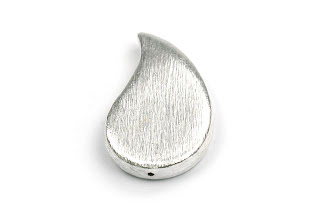
Sterling Silver Shark Tooth Brushed Italian Bead


I've always found beads and jewelery making strongly therapeutic. The focus washes away all worries and I come out of each design session feeling strangely more refreshed and lucid. However, it wasn't until recently that I received some confirmation of the benefits of beads and the girls made little bracelets to keep. It was a hit and they had lots of fun. The beads were very inexpensive, and I was almost appalled they used plastic beads and poorly painted wooden beads. The parents thought it was the best and the kids were thrilled. The bead snob in me decided to show them what good beads look like, and I was going to outdo everyone with the best sterling clasps look like, I thought I could teach them how to finish their own pieces properly. So, it wasn't a bead party that would end all bead parties.

There was a brother (age 6) and sister (age 8) who were part of the group that came out. I actually didn't invite the brother even though he was my daughter's best friend. I naturally assumed that he would not be interested because his parents seemed so gender conservative and dressed him mainly in greens and blues. He had also declined attending parties which my daughter didn't go because he didn't want to be the only boy. My daughter is a tom girl, so he feels she doesn't count as a girl. Anyhow, his mother asked if she could bring him. I was embarrassed of my assumption and wholeheartedly welcomed them. But I brought out my daughter's collection of shark's teeth fossils, boxier sterling clasps and thick leather, just in case if the beads don't go over very well. The boy's mother is a neurologist at the Sick Children's Hospital, i.e. a brain specialist. His father is a paediatric heart specialist at the same hospital. So, they're really into the development of children. While the children are engrossed in the platters full of beads, the mother told me why she encourages her son to do beading. In fact, she has beads at home and she had read many studies that point to the benefits of bead counting and sorting for a child's brain development. Not only will it improve their mathematical skills, it helps develop patience. It also has calming effects on hyperactive children. The size of the beads should vary inversely with the children's age for safety, of course. The little boy is brilliant and very patient. However, I don't know if that has got more to do with genetics than just a lot of bead sorting.

The session was a smash and the mothers were intrigued, and rather dazzled by the array of glass beads, crystals, pearls and stone beads. I find that an easy finish for the bracelets were the lobster clasp . Or for slightly older children and limited budget, one might consider the larger spring ring clasp.

You can certainly contribute to the well being of your friends and family. The necklace making party only took about 2 hours, but it was great for them. The moms wanted to offer money so I'd hold it again. The kids didn't want to go. So, it was worthwhile. I'd recommend larger shell beads. Czech crystals are great. Stringing material can simply be elastic for the little ones.

By the way, the pirate's necklace with the shark tooth was amazing. I used 22 ga sterling wire and wrapped around the tooth, ending in a loop for leather to go through. I think he will treasure the necklace forever.

Saturday, September 12, 2009

The Art of Creative Jewellery Designing


The title of this article seems grammatically incorrect. However, there is no mistake. There is the science and discipline of jewellery making, even jewellery designing. Then there is the art of it. And to top it off, there is certainly the art of creative jewellery designing. Empirical method and precise routine is import in any business, even if it is jewellery making, because it helps ensure repeatability, accountability, and viability, if combined with many other factors. However, there is the art of designing. It is essentially random creativity. There are talented writers who work nine hours solidly every day, 6 days a week. Then there are those whose genius shows through throwing together thoughts and ideas that, independently, make no sense but, together, seem inseparable. I want to talk about that kind of creativity in jewellery designing.

There are some jewellery designers who work at designs over and over again, virtually splitting hairs. Sometimes it is beautiful, but often the rigidity with which they had made the piece shows through. The jewellery components seem to go together, but they don’t gel and become something greater than the combination of themselves. It is almost like the Pointilism art movement of pictures created by the tiniest of dots. There is something desirable about the obvious painstaking work involved, but it lacks flow, drama or gusto. Designers who mull over jewellery components and rework them for too long are usually obsessed with symmetry. I go through phases of designing and am sometimes guilty of doing the same. This is usually following a bad season, but not bad enough for me to become infuriated and rejecting of all convention and advice. When I am in this phase, I am hesitant and think that if I worked hard enough at something, then the work will come through and people will want to buy the jewellery. Inevitably, I become somewhat correct. I avoid a disastrous selling season, but I don’t have boundary shattering masterpieces and phenomenal sales.

I find I am most creative, and where the collection provides the best sales results, when I am in a true bind with time. When that happens, I don’t have enough time to over-think my jewellery components. I simply throw them together, sometimes quite literally, and usually they land in some unconventional position or manner. Some of my best collections were all designed within less than 14 hours. The handwork and additional colour combinations of those designs might take a little longer, but no more than another rush of creativity when I’m rushed. Who says gold, silver and rhodium chains cannot be fashioned together with pearls of opposing colours? Or that fine filigree will be outweighed by heavy chunks of stone? Or oxidized chains combined with high shine silver? I've taken a number of our textured findings and oxidized them, and put them together with gold vermeil and roman coins . It created an old world charm with the rich sheen of gold. I could have gone further to throw in red jade and some matte lava rock. Unique.

I didn't do very well in fine arts. Although I had what I will admit as talent in portraiture, I lacked confidence and fluidity in all other areas of studio art. The same can be said about me personally. But when you don't have time to worry about perfection, you become less rigid. The very fact that you don't have time, or you don't have all of the normal ingredients you'd like, gives you an excuse to liberate yourself from one's shackles of limitation most people put on themselves. Then, it becomes okay to throw jewellery components together. And it’s perfectly acceptable that things aren't perfect because....

The art of creative jewellery designing is then the removal of the effort, science and logic of piecing jewellery components together. Let the components fall where they may (but edit a little).